What StoreFrame is to Me and It's Personal.

So you know the person behind it. Not a sales pitch, just what StoreFrame is to me: a home for my team, my notes as working code, and the impossible thing I'm glad I tried to build.
It's my digital home
StoreFrame, for me, is home. It's where I'm connected with my remote team, my customers, my partners and my own thoughts.
Every morning, instead of opening Jira tickets, emails and everyone else's systems, we open our own and work there. We know if it's running, we know if it's ill, because we use it ourself every day. I can share my thoughts with my team, and they can share theirs with me. I can pick up their work and see where they got stuck, and they can review my work and carry it on. I can asked AI how my team write their prompts, how they structure their code and same goes with them checking what I am doing. There is no need to wait for the end for a sprint review, I can simply asked AI to rewrite the entire chat history person to person. Same with my team and same with my customers (if they asked too).
Many times I have continued my team work where they left of, sames goes with mine. If I am tired waiting for Claude to ultrathink, I can simply hand it off to my team. They can continue the chat, discover the intent, check the plan, double check it with their own expertise. This is development around the clock across remote teams.
Its value goes beyond hosting and infrastructure. For us it isn't a nice-to-have. It's something we need.
Pick a title, any title
I can call myself whatever I want: a designer, a DevOps, a DevSecOps, a hacker, a CTO, or nobody at all. It doesn't matter. I never liked programming in the first place, yet I like connecting things together. As an interaction designer, it's us who translate human language into system language. Thats the job. The programming is what comes with it.
I chose platform engineering, and not because I write the perfect CI/CD pipeline or a best-in-class Ansible workflow. No. It's because platform engineering, at its core, is about building a platform that connects the people in an organization. It smooths the internal process, helps my team and my customers get the most out of us, and keeps everybody aligned. I think that's the real value.
My notes, but running
I started as a developer through trial and error, copy-pasting from Stack Overflow. For years I kept lots of code snippets in my notes for doing this and that, until that got impractical.
So instead of piling up notes, GitHub stars and bookmarks, I put it all into a system as working code. A bookmark is fire-and-forget. Building the thing, doing the actual work, is what makes me remember it, and see how it really works and fits with everything else.
With AI today, it keeps growing, fast. At least the system also keeps track of all of it for me. Maintaining it is another drama, of course. It's inevitable.
Honestly, Magento bores me sometimes
We deal with Magento every day. Even after almost two decades there's still something to do, to fix and to learn every day, no matter who you are. But at the end of the day, it's still Magento. And sometimes, as a human, I'm very bored of it.
So StoreFrame begins as the perfect side project. It's not me improving in Magento. It's me improving how the Magento work itself gets done.
And just in case one day there's no Magento, my whole career doesn't go in the bin. I can still show my design skills, my engineering principles, my architecture, and how I solved the boring parts. It's my portfolio, not bound to any certificates and client's demands. Freedom to express. The language, the framework and everything else can go in the bin tomorrow. The knowledge and experience stay, even beyond StoreFrame itself.
Building a control panel is seriously f'ing tough
Seriously. Ask anyone in the industry, or your own team. If it were easy, everyone would have one. The fact that they don't tells you a lot. You have no idea how much money has gone into building version after version of it over the years.
I've been through thousands of VM provisionings on Hetzner, from zero to just production grade Magento. Literally thousands, to get the variability and the dependencies structured. And it had to adapt to whatever is already there, and to whatever comes in next.
Yet the most bullsh*t part is that you can't release a control panel half-baked. This is a serious one. When is it enough to release, and where does it end? That was hard to define. I can't ship StoreFrame as just a store-creation wizard alone. And catching up from zero with systems that have been around for decades is absolute insanity, especially doing it all alone, bootstrap.
But guess what: my stupidity and not-knowingness in trying to build the impossible is exactly what landed me here. If I'd known from the start what it would take, 90% of me would have said no. It just so happens that I have most of the parts built, AI covers the missing technical-gap. As long as I made sure it did what it does responsibly.
AI is a calculator, not math
AI is transformative. Whether you like it or not, whether you agree or disagree, whether you use it or not, whether the bubble is about to burst, it doesn't matter. As I see it, it's here to stay, and for a very long time.
If you're a developer worried about losing your job to it, you shouldn't be. Let me explain why. At the very least, today I consider AI a calculator. A calculator helped people count, but that doesn't solve math. We've gone through many iterations of it: counting by hand, the abacus, the calculator, the computer, the server, and now AI. Through all those years, math is still a subject and teachers still exist today. It won't go away. What it does will just transform into a new form.
If you ask me, it's designers (like me, the ones just doing UX/UI) who will most likely face massive job cuts first, because the new Claude Design has superseded Figma by a mile. It creates UX/UI so well, so quickly and so complete that customers will probably think you're incredibly fast and professional. I still remembered how I needed to make designs in Photoshop. Multiple 1GB psd file nightmare when the customer wanted to test 5 different header layout where you already complete 10+ pages. Horrible. Sketch and Figma solved it elegantly (kudos to components and auto-layout), but wait until you wanted the design to be responsive, alive, animated and clickable.
So don't worry fellow developers. We still have thousand-miles of cybersecurity to worry about and plenty of legacy tech debt to cover in the coming years. Hahaha.
Criticism welcome
StoreFrame is also a way to find out what's right and what's wrong. Nobody likes criticism, including me. But praise alone won't get me anywhere. It's the customers' complaints, and being brave enough to face criticism, that do.
When I first released it, it wasn't good enough. I agree. Even now I think there are many places that still need an update.
Someone criticised running Docker with just single-user access as not secure. True. Having to wait 30 minutes for a new store is slow. Also true. So we got to work and fixed things along the way.
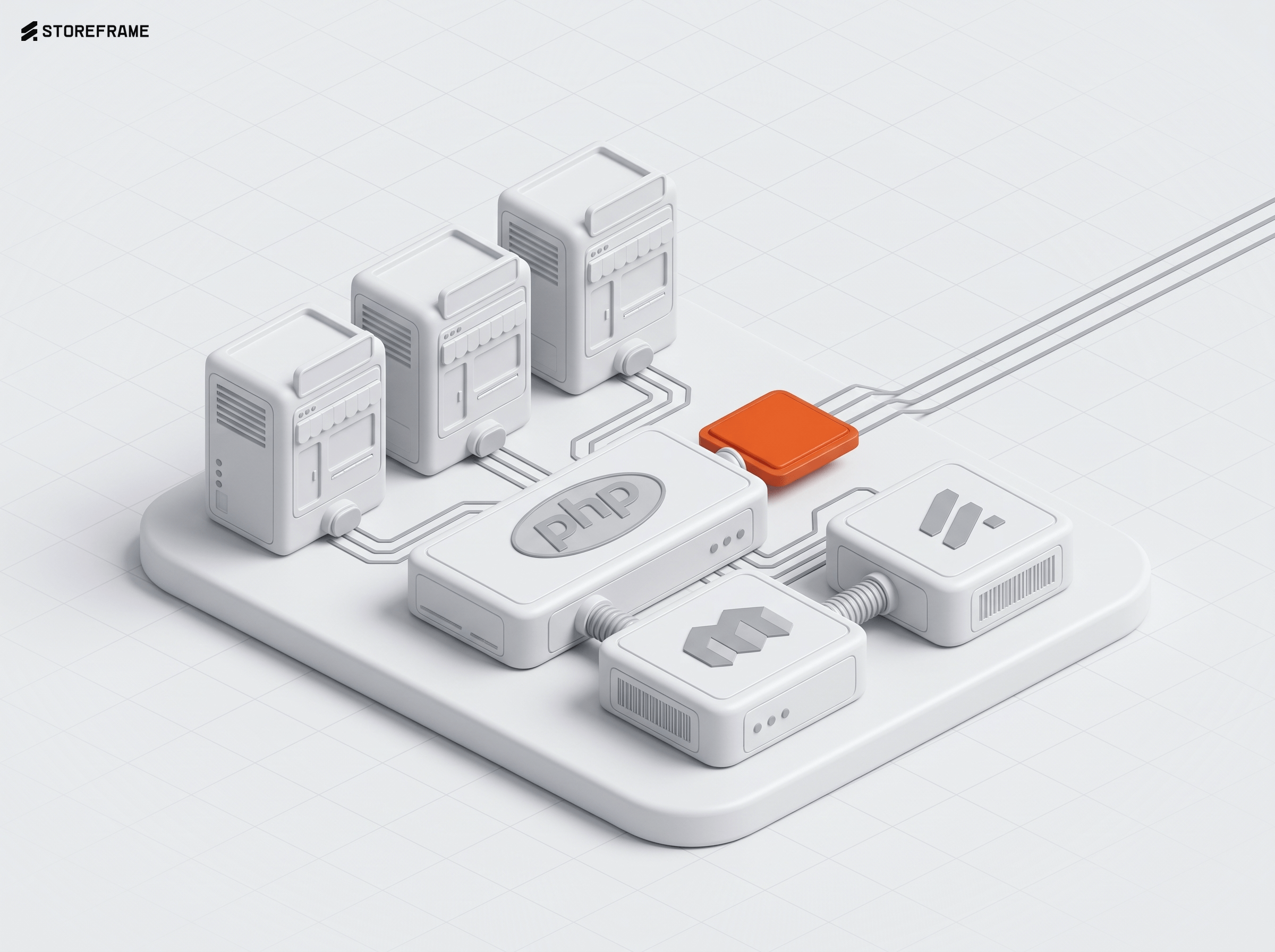
Now we run three PHP containers instead of one: one for the web app, one for the PHP CLI and one for the deployer. We made the web-app container as read-only as possible. Then we added more: AppArmor and seccomp. Maybe soon we'll replace it with Podman and FrankenPHP. Whatever it needs to be, with an easy roll-out. Don't worry, it will be there.
You don't have to come in
Business-wise, I'm not even close to a marketing or sales guy. If I wanted to make big bucks fast, the easy pick was to build something that sits next to, on top of, or alongside Hypernode or the other big names. Easier to promote, less friction.
Because like me, and like you, developer: nobody likes changing hosting, especially when you host many, many, many webshops. It's no fun, boring and it's risky (inc. getting out of comfort zone).
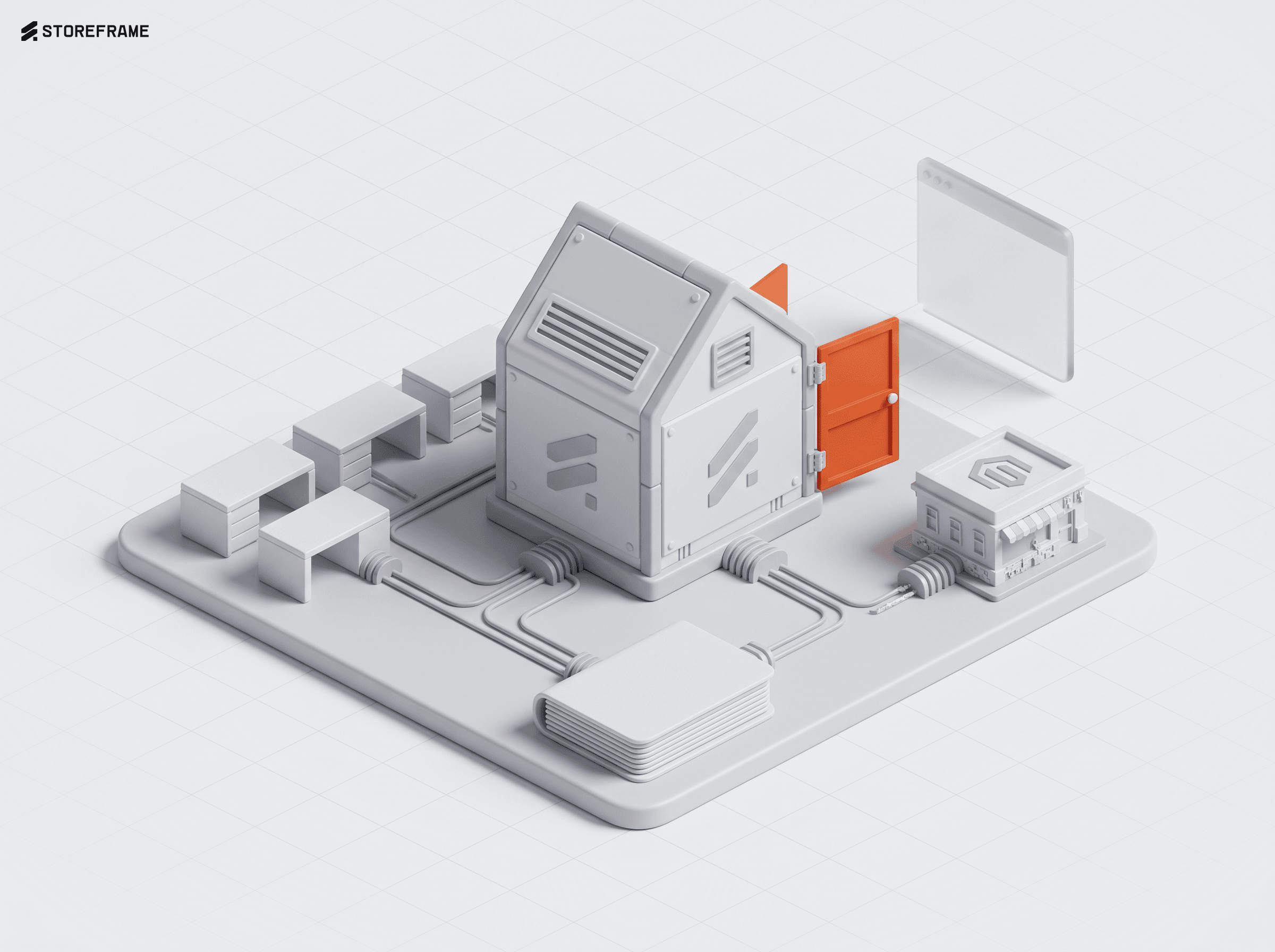
I built StoreFrame because I needed it, the way I wanted it, the way I want to run it. It just happens that I open my front door. That doesn't mean you have to come in. Maybe you shouldn't, and it's okay too sticking with what you have.
A founder, an engineer at heart, an independent consultant who seek alternatives to the mainstream — Currently focused in burning AI tokens to deliver the best agentic e-Commerce experience.
More Articles
More Articles
A PHP vulnerability dropped the night before Meet Magento Germany. Ten things I took home: about people, patching, merchants who choose offline, and why badges don't stop bugs.
PWA Studio, Vue Storefront, GraphCommerce, Rapidez, Breeze and Hyva: why headless Magento kept losing to cost, and why AI that writes JavaScript fluently may finally flip the verdict.
Every Magento merchant asks whether the platform will still be here, and still be free, in five years. We stopped answering shop by shop and moved every customer to Mage-OS. Here's why.
One decision saved us setup time on every store, kept catalogue pages fast and stopped more bots: a self-hosted, Turnstile-style challenge that installs itself.
More than ten detectors score every request before anything is decided. Here is the scoreboard, what each signal is bad at, and the customers we annoyed on the way.
Every bot says it is Chrome. The handshake says otherwise. How we read JA4 and HTTP/2 fingerprints at the edge, why we needed both, and where they fail.